When we think about vitamin D, we often think about bone health. But this important nutrient and hormone-like substance may also play a role in supporting your eyes, tear film, and ocular surface.
If you struggle with persistent dry, irritated, or uncomfortable eyes, vitamin D deficiency may be one of several factors worth discussing with your doctors.
What Does Vitamin D Have to Do With Your Eyes?
Vitamin D receptors have been identified throughout the eye, including the cornea and other ocular tissues. Research suggests that vitamin D plays a role in maintaining ocular surface health and helping regulate inflammation.
This is especially important for people with Dry Eye Disease (DED).
Dry eye disease occurs when the eyes do not produce enough tears, when tears evaporate too quickly, or when the tear film is poor in quality.
How Can Vitamin D Deficiency Affect the Tear Film?
Studies have found an association between low vitamin D levels and several signs of dry eye disease, in fact, about a 28.6% higher risk of dry eye disease with deficiency (Shmushkevich et al).
Vitamin D deficiency has been linked to:
- Reduced tear production
- Poorer tear stability
- Shorter tear break-up time
- Increased tear film osmolarity
- Greater ocular surface inflammation
- Worsening dry eye symptoms
Research suggests that vitamin D may support the ocular surface in part through its role in regulating the body’s immune and inflammatory responses.
In patients who are vitamin D deficient, supplementation has shown promising results as an adjunct to traditional dry eye treatments. However, vitamin D is not a one-size-fits-all treatment, and more research is still needed to understand exactly how supplementation can best support patients with dry eye disease.
What about Vitamin D and the Retina or Optic Nerve?
Vitamin D deficiency is linked to a two-fold increase in diabetic retinopathy and worsening diabetic retinopathy if you are a diabetic compared to non-deficient patients.
Vitamin D deficiency is also linked to reduced ganglion cell complex (GCC) of the retina and optic nerve, whereas normal vitamin D levels are thought to be neuroprotective. Also, if you think about the eye and retina as an extension of your brain, then if we can protect the retina, we can also protect the brain. In fact, vitamin D deficiency (<30 nmol/L) is associated with a 25% higher risk of all-cause dementia, a 19% higher risk of Alzheimer disease, and a 24% higher risk of vascular dementia (Chen et al).
Where Can You Get Vitamin D?
Only a limited number of foods naturally contain significant amounts of vitamin D. Some dietary sources include:
- Oily fish, such as salmon and sardines
- Egg yolks
- Red meat
- Liver
- Fortified foods, such as certain milks and cereals
Your body can also produce vitamin D through sunlight exposure. However, many factors including lifestyle, geographic location, skin pigmentation, age, and sun-protection practices can affect how much vitamin D your body produces.
Should You Take a Vitamin D Supplement?
This is an important question to discuss with your primary care physician.
Your vitamin D needs depend on several factors, including your current vitamin D level, overall health, medical conditions, medications, and nutritional needs. A simple blood test measuring your vitamin D level can help your healthcare provider evaluate your vitamin D status. Normal vitamin D levels are between 30 and 70 nmol/L and if you are less than 30 nmol/L , then you can have other symptoms of deficiency, including extreme fatigue.
What are symptoms and signs of Vitamin D deficiency?
- Fatigue
- Myalgia or muscle aches and weakness
- Bone pain
- Bowed legs
- Higher risk of infection with weakened immune system
- Worsening severity of skin diseases like psoriasis
- Cardiomyopathy
Dosage Considerations:
- General Maintenance: Standard daily intake guidelines for healthy adults typically recommend around 1000-4,000 IU/day to regulate standard calcium and phosphate homeostasis.
- Addressing Chronic Conditions & Deficiency: Organizations like the Endocrine Society suggest that individuals with documented deficiencies, systemic conditions, or severe chronic inflammation may require higher therapeutic doses (sometimes 5,000 to 10,000 IU/day or 50,000 IU once per week under strict medical supervision).
- This is best addressed with your regular doctor. Do not supplement without knowing your levels.
- You may have heard about the D3+K2 version of vitamin D and see it being sold in stores. This formulation became popular when vitamin K was shown to help vitamin D direct calcium into bones instead of the endothelial cells of your blood vessels and help decrease osteoporosis in vitamin-D deficient patients. Please ask your doctor which formulation is best for you if you are deficient.
While vitamin D supplements can be beneficial for people with a deficiency, more is not always better. High doses may be medically appropriate in certain cases, but they should only be taken under the guidance of a qualified healthcare professional. Vitamin D is one of the fat-soluble vitamins that can be stored in your fat and liver and can build up to toxic doses.
Please consult your primary care physician to determine whether vitamin D supplementation is appropriate for you and what dosage is right for your individual health needs.
Dry Eye Disease Requires a Personalized Approach
Vitamin D may be one piece of the dry eye puzzle, but it is rarely the only factor.
At Eye Doctor MD, PC, we believe in identifying the underlying causes of your symptoms. Depending on your individual needs, dry eye treatment may include:
- Artificial tears and lubricating eye drops
- Anti-inflammatory treatments
- Management of meibomian gland dysfunction
- IPL therapy
- OptiPlus treatments
- OptiLift treatments
- Lifestyle (screen-time management and proper blinking habits) and nutritional support like Omega-3s
- Additional therapies based on the underlying cause of your dry eye
- The book, Goodbye, Dry Eye by Dr. Shilpi Pradhan, can be a good resource.
A comprehensive evaluation can help us better understand what is affecting your tear production, tear quality, and ocular surface health.
Take the Next Step Toward More Comfortable Eyes
If you are struggling with persistent dry eye symptoms, don’t assume you simply have to live with the discomfort.
Schedule a comprehensive dry eye evaluation with Dr. Pradhan to better understand the underlying causes of your symptoms and explore a personalized treatment plan.
And if you are concerned about your vitamin D levels, talk with your primary care physician about whether testing or supplementation may be appropriate for your overall health.
Call Eye Doctor MD, PC at (804) 270-3333 to schedule your dry eye consultation with Dr. Pradhan.
Your dry eyes may have more than one cause. Let’s look deeper and find the right path toward healthier, more comfortable vision.
For more information on caring for your vision and whole-body health, subscribe to our YouTube channel.
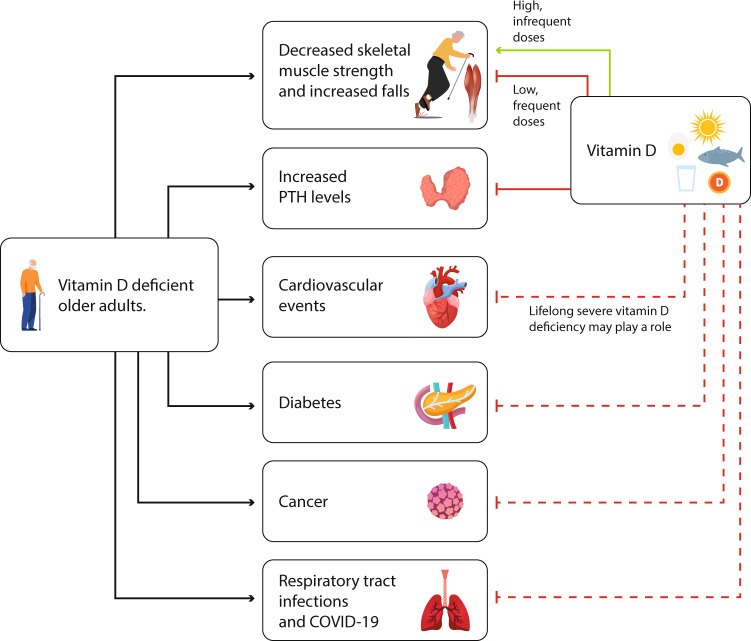
Extra skeletal effects of vitamin D deficiency in the elderly and possible role of vitamin D in preventing them. Continuous lines indicate a known effect. Dashed lines indicate a possible effect (PubMed®)
Sources:
https://pmc.ncbi.nlm.nih.gov/articles/PMC9860626
https://pubmed.ncbi.nlm.nih.gov/35188874
https://nutritionsource.hsph.harvard.edu/vitamin-d/
Shmushkevich SB, Bajrami S, Beauchamp B, Kane JS, Mutawe DL, Hollinger JC, Marks VA, Parekh PK, Rothman AL, Ansari ZA, Williams BK Jr, Galor A. Vitamin D Deficiency and Dry Eye Disease: A Retrospective Cohort Study. Am J Ophthalmol. 2026 Jun;286:132-139. doi: 10.1016/j.ajo.2026.02.036. Epub 2026 Feb 27. PMID: 41765267; PMCID: PMC13428270.
Chen LJ, Sha S, Stocker H, Brenner H, Schöttker B. The associations of serum vitamin D status and vitamin D supplements use with all-cause dementia, Alzheimer’s disease, and vascular dementia: a UK Biobank based prospective cohort study. Am J Clin Nutr. 2024 Apr;119(4):1052-1064. doi: 10.1016/j.ajcnut.2024.01.020. Epub 2024 Jan 29. PMID: 38296029; PMCID: PMC11007746.

Dr. Shilpi Pradhan is a board-certified ophthalmologist, cornea specialist, and founder of Eye Doctor MD PC. Beyond providing advanced clinical treatments for dry eye disease, she guides patients in adopting targeted lifestyle changes to improve both their eye health and overall whole-body wellness. As one of the first Virginia ophthalmologists board-certified in Lifestyle Medicine (2020) and a member of the American College of Lifestyle Medicine (ACLM), Dr. Pradhan combines modern ocular care with evidence-based nutrition and habit changes to support long-term Vision Healthspan.